
From July 8 to 11, 2026, the Tec’s Mexico City campus received global leaders in design and sustainability at the fifth edition of the Transition Design Conference: Weaving Regenerative Futures, a forum co-organized by Tecnológico de Monterrey, Carnegie Mellon University, and the University of Palermo.
The aim of the conference was to promote international collaboration and exchange experiences on topics such as the ethics of care, socio-ecosystemic regeneration, social justice, and democracy.
Through keynote speeches, workshops, and panels, over 200 attendees discussed design as a tool for systemic change, focusing on generating scalable solutions to “wicked problems,” bearing in mind the perspectives of the Global South.

Four themes for imagining a fairer future
Mariana Amatullo, National Dean of the School of Architecture, Art, and Design, said that design should be a force for imagining and materializing fairer, more regenerative, and more resilient futures.
“The transitions that we seek don’t belong to a single institution or a single discipline: they’re a collective effort. These meetings are so important precisely because of this, as they remind us that knowledge is constructed in the community and from the community,” she added.
In this fifth edition, the conference addressed four core themes:
- Projects for Transitions: proposals for projects, strategies, and systemic change for long-term transformation toward sustainability and regenerative futures.
- Cosmopolitan Localism: exploring regenerative futures through local-global perspectives, integrating indigenous knowledge with contemporary design thinking.
- Mindsets for Transition: mental models, attitudes, and visions of the world necessary for enabling and sustaining transitions toward fairer and more regenerative systems.
- Education for Change: syllabuses, tools, frameworks, and pedagogical approaches to educate students and professionals for long-term systemic change.
“Transitions don’t belong to a single institution: they’re a collective effort.” - Mariana Amatullo
The keynote speakers included:
Alfredo Gutiérrez Borrero, leader in sustainable design and systemic transitions; İdil Gaziulusoy, researcher on complex systems and cultural change; Anand Pandian, pioneer in systemic thinking; and Terry Irwin, professor and Director of the Transition Design Institute at Carnegie Mellon University and co-creator of Transition Design.
How to address problems in a pluriversal context
During her keynote speech, Terry Irwin highlighted that both Mexico and the Global South are at a critical point for ensuring a more pluriversal evolution of practice to tackle problems such as climate change and inequity that, although they are not new issues in this region, are manifested differently in each culture.
And these problems, which at one point were only regional, now have global ramifications through ecological, political, technological, and economic systems, most of these problems actually being consequences of higher orderproblems.
Irwin therefore proposes a set of diverse strategies for achieving a regenerative future, starting with strengthening connections between institutions, something she calls “islands of coherence.”
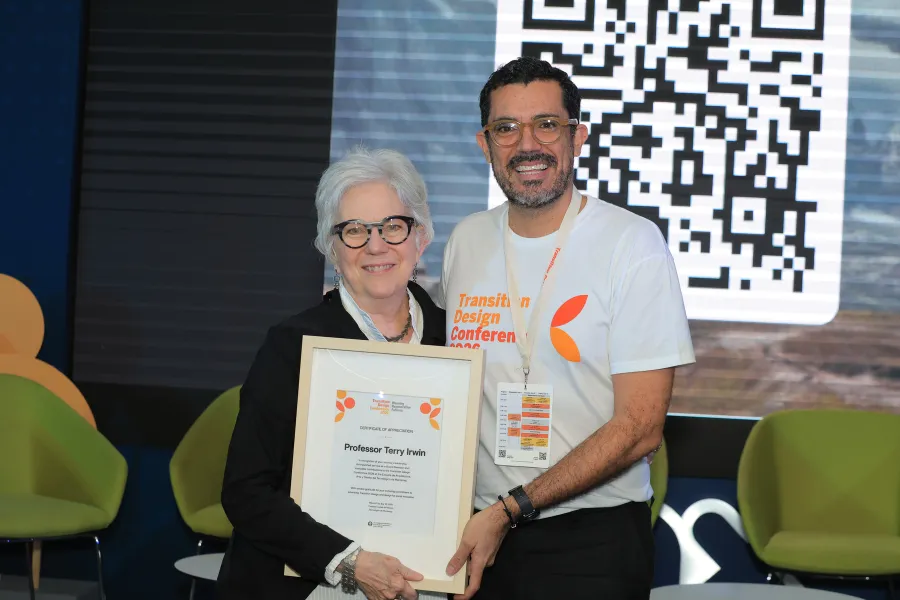
“In this way, we’ll increase our collective capacity to intervene in systems and contribute to the great transitions that we wish to see,” she reflected.
Moreover, she proposed an educational paradigm of universities that exist to serve the community and the region, as well as generating connections with local government, decision makers, activists, and the community, which have transdisciplinary laboratories so that they operate as spaces for co-learning between students and faculty.
Finally, Irwin proposed changing how designers tackle a problem, and instead of seeking a single solution, learn to “dance with systems.”
“Working with systems isn’t about certainty, prediction, or control. It’s about dancing with a system through attitudes of speculation, experimentation, improvisation, and adaptation.
“Dancing means welcoming unconventional perspectives and collaborators, openly sharing values, and resisting the temptation to cling too strongly to a single method, framework, or ideology. If there’s a mindset to cultivate, it’s one of imagining that things can be radically different,” concluded Terry Irwin.
“If there’s a mindset to cultivate, it’s one of imagining that things can be radically different.” - Terry Irwin
What is Transition Design?
The Transition Design Institute at Carnegie Mellon is a resource for those working toward positive change at systemic level.
21st century societies are facing innumerable “wicked problems.”
Transition Design forms part of a growing global movement of academics, researchers, and professionals who believe that communities, organizations, and societies as a whole should deliberately transition toward futures that are more sustainable, equitable, and desirable.
With information from Lorena Marquina and the Transition Design Institute.
READ MORE: