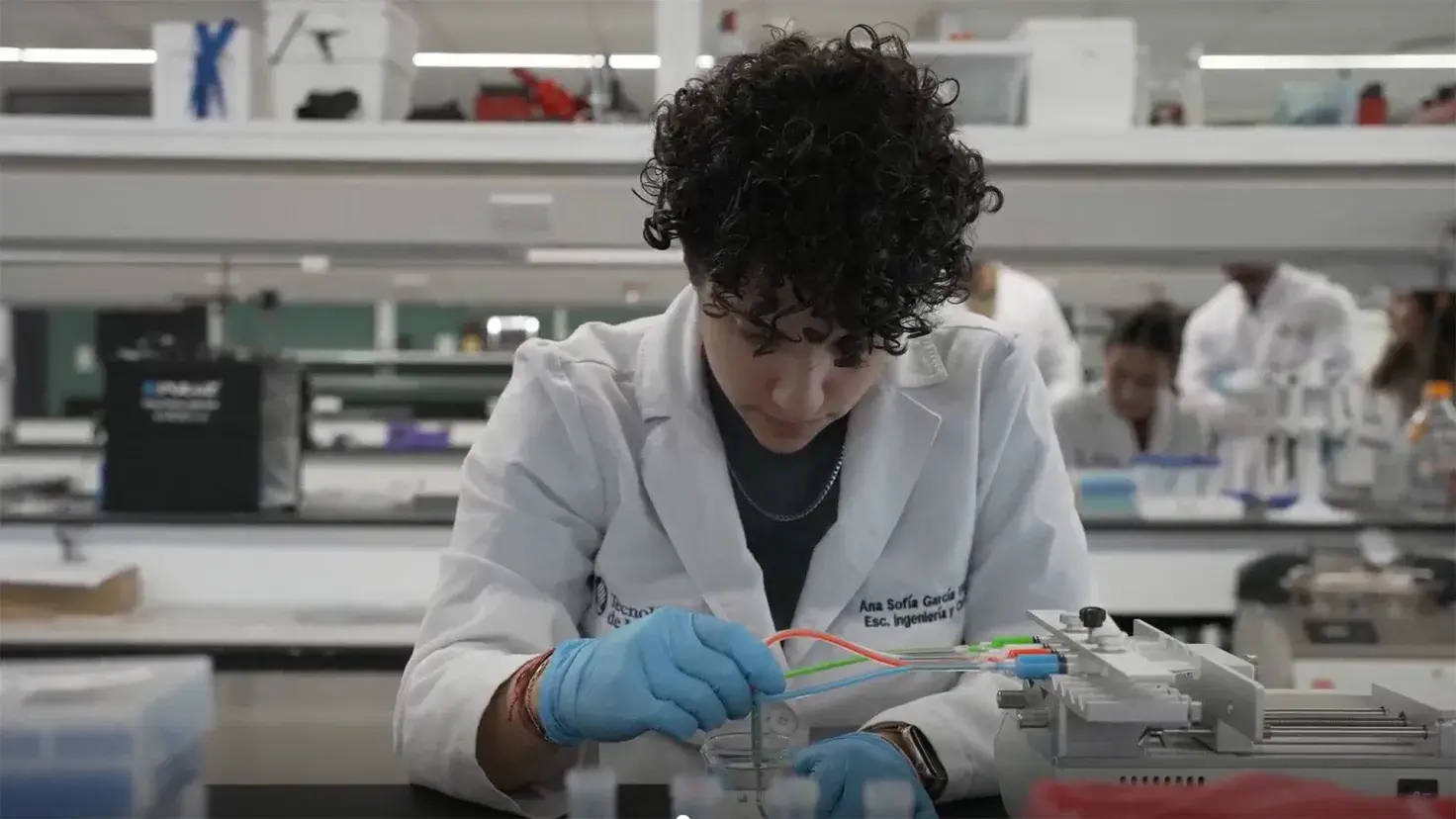
The International Conference on Biofabrication, one of the world’s most important events in this field, will be held in Latin America for the first time in nearly two decades.
Monterrey campus will host Biofabrication 2026, an international conference that will bring together researchers, students, and specialists in fields such as bioprinting, tissue engineering, and regenerative medicine.
According to the event host, Tec de Monterrey’s Álvarez-Trujillo Advanced Biofabrication Laboratory, this year’s event offers an opportunity to bring the Latin American scientific community into closer contact with leaders in this field.
“This will be an opportunity for those groups. I believe Latin America will be in a very strong position in the coming years,” said Mario Álvarez, co-director of the laboratory.

A global event
This annual conference rotates among the regions of the Americas, Europe, and Asia-Oceania.
However, in the Americas, it had only been held in the United States and Canada.
“It’s a community that isn’t huge, but it’s not so small that it feels exclusive either. You have access to both world-renowned leaders in this field and young researchers,” said Grissel Trujillo, research professor and co-director of the lab.
During the conference, which will be held from November 2 to 6, there will be presentations on advances in bioprinting, organ and tissue engineering, three-dimensional biological models, and applications in skin, cartilage, and cultured meat.
The conference will feature six plenary sessions and approximately 60 speakers who will address these topics.
Yu Zhang, one of the organizers of Biofabrication 2026, highlighted that this conference brings together the international community every year to discuss the major advances in this field.
“It’s the place where the entire biofabrication community comes together and where the most significant advances in this field are presented,” said the professor from Harvard Medical School.
According to Zhang, a pioneer in biofabrication, this first edition in Latin America will help engage more researchers from the region and strengthen global scientific collaboration.
An opportunity for Latin America
One of the goals for the 2026 edition will be to increase the number of Mexican and Latin American groups that participate.
Álvarez, who is also a research professor at the Tec, said that there are teams in Mexico developing tissues to test drugs, study infections, and carry out projects related to coral restoration.
“We’d like to invite the Mexican community. There are already several groups working in the field of biofabrication, although not all of them refer to what they do by that name,” he said.
“This event is where the entire biofabrication community comes together and where the most significant advances in this field are presented.” - Yu Zhang
He pointed out that there are prominent groups in countries such as Brazil, Costa Rica, Colombia, and Argentina, so the event will serve as a platform to raise awareness of their work.
Trujillo highlighted that collaborative networks are essential for identifying problems, sharing solutions, and developing new scientific projects.
“We’re thrilled to be organizing the conference to provide an opportunity to promote the event and network. We believe this part of the world has great potential, and we want everyone to discover it,” she said.
Support for young researchers
The event will also offer professors and students who are in the early stages of their careers the opportunity to interact with internationally renowned experts.
Álvarez highlighted that young people studying fields such as biomedical engineering, biotechnology, medical sciences, and nanotechnology will have the opportunity to meet researchers whose articles they study during their education.
“We’re going to bring in the leading experts in the field, the people whose articles you read in your graduate-level classes. They’re going to come here now,” he said.
Zhang agreed that younger generations will need to participate in order to ensure the future of the discipline.
According to the researcher, participating in these events can open new doors for them to explore different fields, establish collaborations, and become the next leaders in biofabrication.
“We’re going to bring in the leading experts in the field, the people whose articles you read in your graduate-level classes.” -Mario Álvarez
The challenges of biofabrication
Although this field has made progress over the past two decades, Zhang highlighted that it is still in its early stages, and that much of the work continues to focus on prototyping and technological development.
The next challenge will be to demonstrate that these technologies are biologically viable and can be translated into clinical and practical applications.
He also pointed out that artificial intelligence is already beginning to be integrated into biofabrication to improve processes such as drug discovery and the development of more autonomous bioprinting systems.
Monterrey as the host city
Zhang highlighted how Tec de Monterrey provides an environment that fosters cutting-edge research.
He also recognized the work of the Álvarez-Trujillo Laboratory in technologies such as chaotic bioprinting, which was developed at that institution.
According to the researcher, hosting the conference will allow international visitors to learn about the projects being carried out locally and, in this way, create new opportunities for collaboration.
The organizers hope that Biofabrication 2026 will help create a regional ecosystem that brings together universities, research centers, companies, startups, and investors.
“We’d like Mexico and Monterrey to become fertile ground where our students can develop their professional careers in these fields,” said Trujillo.
These researchers see the conference as an opportunity to showcase the scientific potential of Mexico and Latin America, as well as to bring a new generation of specialists into the global biofabrication community.
YOU MAY ALSO BE INTERESTED IN READING: